How to Choose the Right FDE Company: The Complete 2027 Buyer's Guide
10 essential criteria for selecting a Forward Deployed Engineering partner, from technology platforms and industry expertise to security, costs, and measurable business results.

New to FDE?
If you're not sure what a Forward Deployed Engineer (FDE) or Forward Deployed Finance Engineer (FDFE) is, start with our explainer: What Is a Forward Deployed Engineer (FDE)?
Choosing the right Forward Deployed Engineering (FDE) company can determine whether an enterprise AI initiative becomes a valuable business capability or another expensive experiment.
Unlike traditional technology consultants who may focus primarily on strategy and recommendations, Forward Deployed Engineers work directly with customers to design, build, integrate, and deploy solutions in real operating environments.
But not all FDE providers are alike.
Some are independent consulting firms offering AI implementation services. Others are technology companies with dedicated FDE teams that build solutions on top of their own software platforms. Their capabilities, delivery models, and long-term economics can differ significantly.
According to OpenAI's explanation of Forward Deployed Engineering, an important challenge is closing the deployment gap: the distance between what AI models can theoretically accomplish and what organizations can reliably use in production.
The central question is no longer simply who can build an AI solution fastest. It is who can build a reliable solution on the right technology foundation, deliver measurable business value, and leave your organization capable of operating and expanding it.
Here are the 10 most important factors to evaluate.
Get the Top 10 FDE Companies in the USA (2026)
Skip months of research. Our ranking compares ten leading Forward Deployed Engineering providers side by side, with scores, strengths, limitations and links to each vendor, weighted for finance teams. It's the fastest way to build a strong shortlist.
1. Provider Type: Technology Company vs. Consulting Firm
Before evaluating individual engineers or project pricing, understand what kind of company you're hiring.
There are two particularly important models to distinguish.
| Independent FDE Consulting Firm | Technology Company With an FDE Practice | |
|---|---|---|
| Core offering | Engineering and implementation services | Software platform plus engineering expertise |
| Technology | Typically integrates third-party platforms | Can build on its own technology |
| Infrastructure | May require additional custom development | Can reuse existing product capabilities |
| Product engineering | Depends on external technology vendors | May have direct access to core product teams |
| Ongoing improvements | Often involve additional implementation work | May be delivered through product updates |
| Flexibility | Potentially greater technology independence | Often optimized for a particular platform |
Why technology-native FDE providers can have an advantage
A company that develops both the underlying software and its FDE capabilities can combine two valuable assets: a mature technology platform and engineers who understand it deeply.
Rather than building integrations, data infrastructure, and operational controls from scratch, its engineers may be able to reuse existing capabilities.
And when a customer's requirements expose a limitation in the platform, the FDE team may have direct access to the engineers who develop the underlying product.
This model is associated with companies such as Palantir, whose Forward Deployed Engineering approach is closely connected to its Foundry and AIP platforms.
OpenAI's FDE organization similarly works directly with its product and research teams to help customers bring complex AI applications into production. OpenAI distinguishes this work from conventional professional services, illustrating why the FDE label does not necessarily imply the same service model across providers.
In financial technology, Datarails AI Implementation Services offers another example of a platform-based approach, combining its FinanceOS technology with dedicated Forward Deployed Financial Engineers to build financial workflows and AI-powered solutions.
These models are not interchangeable, and technology ownership does not automatically make one provider superior.
An independent consultancy may be a better fit when a company already has a mature infrastructure, needs to combine competing technologies, or values vendor-neutral recommendations.
Questions to ask:
- Does the provider own a software platform or primarily implement third-party technology?
- Which capabilities are already available, and which require custom engineering?
- Can the FDE team work directly with the company's core product developers?
- What technology partnerships does the provider have, and what practical benefits do they offer?
- How much of the solution will remain dependent on the provider after deployment?
Bottom line: A technology company with a mature, relevant platform and a strong FDE team may have a significant structural advantage. The key is verifying that its existing technology actually reduces implementation complexity and improves outcomes.
2. Technology Foundation: Why an LLM Alone Is Not Enough
This is one of the most important and frequently overlooked considerations when selecting an FDE provider.
Many AI projects begin by connecting a large language model, such as ChatGPT or Claude, to a company's existing software applications.
For simple use cases, this may be sufficient. For complex enterprise workflows, however, a language model and a collection of API connections are rarely the complete solution.
An LLM provides reasoning capabilities. It does not inherently provide the business data, operational rules, permissions, and controls required to run an organization.
Consider a finance manager asking an AI agent:
"Why did our gross margin decline last quarter compared with budget?"
A reliable answer may require combining data from an ERP, CRM, payroll system, and Excel models while applying the company's accounting policies, chart-of-accounts mappings, currency conversions, and reporting definitions.
Without a trusted underlying data foundation, the AI could produce a convincing explanation based on inconsistent or incomplete information.
This distinction is consistent with Microsoft's guidance on enterprise AI data architecture, which emphasizes the importance of unified, secure, and governed data for reliable AI agents.
The importance of a Finance Operating System
For organizations building AI solutions across financial processes, a Finance Operating System (FinanceOS) or an equivalent governed financial data and workflow layer can provide the necessary foundation.
A capable financial operating platform should offer:
- Unified Data Model: Financial and operational information consolidated across ERP, CRM, banking, payroll, and other systems.
- Semantic Layer: Consistent business definitions for revenue, EBITDA, gross margin, cash flow, and other financial metrics.
- Financial Logic: Account mappings, multi-entity consolidation, currency conversion, allocations, and reporting rules.
- Governance and Permissions: Role-based access, approval mechanisms, audit trails, and data lineage.
- Operational Workflows: The ability to execute business processes with appropriate controls and human oversight.
- Reusable Infrastructure: Shared integrations, business logic, and security controls that can support multiple AI agents.
For example, Datarails FinanceOS provides a governed financial data foundation connecting financial and operational systems. It supports financial reporting, planning, and AI applications through shared data, logic, and controls.
A finance organization with mature existing infrastructure may already possess many of these capabilities. A separate FinanceOS product is not universally required. What matters is whether the necessary financial data and operational controls are available and reusable.
Platform-first vs. LLM-first implementation
Consider two implementation approaches.
LLM-first: Individual agents connect to business applications and implement their own data retrieval, business rules, and workflows. Without shared infrastructure, this can result in duplicated logic, inconsistent outputs, and growing maintenance requirements.
Platform-first: Agents operate on a shared, governed foundation that already manages financial data, definitions, permissions, and integrations. New applications can reuse these capabilities rather than rebuilding them.
Neither approach is inherently wrong. The appropriate architecture depends on the use case, existing infrastructure, and operational requirements.
However, for organizations planning multiple financial AI applications, the platform-first approach can offer meaningful advantages in consistency, governance, and scalability.
Questions to ask:
- What technology platform will our AI solutions run on?
- Is there an existing unified data model and semantic layer?
- How are financial definitions and calculations managed?
- Can AI-generated results be traced back to authoritative source data?
- Can multiple agents share integrations, permissions, and business logic?
- What must be built from scratch, and what is already available?
Bottom line: Evaluate the technology foundation as carefully as the engineering team. For complex financial applications, a governed operating layer can be as important as the AI model itself.
3. Industry Expertise and Business Understanding
Technical excellence does not automatically translate into industry expertise.
An FDE team experienced in customer support automation may have limited understanding of financial consolidation, month-end close, accounts receivable, or treasury operations.
Without sufficient domain knowledge, implementation can require extensive involvement from the customer's internal experts, increasing costs and slowing delivery.
For finance projects, look for providers that understand accounting processes, financial reporting, industry-specific software, and relevant regulatory requirements.
This specialization is increasingly associated with the role of a Forward Deployed Finance Engineer (FDFE), which combines financial domain expertise with software engineering, AI, and automation to develop solutions for finance departments.
The strongest teams should also be able to identify opportunities for improvement rather than simply implement requested features.
Sometimes the best solution is not another AI agent. It may be correcting an underlying data problem or improving an existing workflow.
Ask: "Can you demonstrate a production project involving business processes similar to ours, and explain the measurable outcomes?"
Prioritize relevant experience and genuine business understanding over generic AI credentials.
4. Proven Track Record and Production Results
A polished AI demonstration is not proof of production capability.
The real test is whether the solution performs reliably with actual users, imperfect data, changing requirements, and everyday business constraints.
Ask for comparable customer deployments that have been operating in production for a meaningful period.
Evaluate:
- How many comparable projects reached production?
- What measurable improvements did they deliver?
- How widely are the solutions used?
- What problems emerged after deployment?
- Can the provider offer relevant customer references?
Where possible, speak directly with customers who have operated the solution for several months.
Ask: "Show us a comparable production deployment and explain how its performance and business impact have been measured."
Be cautious of providers that rely almost entirely on demonstrations or proof-of-concept projects.
5. Engineering Quality and AI Expertise
The success of an FDE engagement depends heavily on the engineers assigned to the project.
Do not evaluate the provider solely through its founders, executives, or sales engineers.
Meet the actual delivery team.
Effective FDE engineers combine software development, systems architecture, AI expertise, integration capabilities, and business communication skills.
They should understand how to build reliable agent workflows, evaluate model outputs, handle failures, and determine when conventional automation is preferable to AI-based reasoning.
Also clarify whether engineers are dedicated to your project or shared across several customers.
Ask: "Can we meet the lead engineer, review a comparable architecture they personally delivered, and understand their role after launch?"
The quality of the assigned team matters more than the sophistication of the sales presentation.
6. Production Readiness, Reliability, and Support
Moving an AI application into production requires considerably more than making it work during a demonstration.
Production systems need appropriate testing, monitoring, logging, error handling, recovery procedures, and ongoing maintenance.
The provider should be able to explain what happens when a data integration fails, an agent produces an incorrect result, or a workflow encounters an unexpected condition.
It should also define clear ownership of incidents, escalation procedures, support availability, and operational responsibilities.
Ask whether the organization will receive sufficient documentation and training to manage the system independently.
Ask: "Show us how your solution detects failures, handles exceptions, and recovers safely in production."
A provider should demonstrate not only how its solution works, but also how it behaves when something goes wrong.
7. Security, Compliance, and Governance
AI applications frequently interact with sensitive business and financial information.
Evaluate authentication, access permissions, encryption, data retention, audit logging, and controls governing AI-driven actions.
For finance organizations, particular attention should be paid to confidential reporting, payroll information, payment approvals, and segregation of duties.
Security must be enforced by the underlying applications and infrastructure, not simply by instructions telling an LLM what it should or should not do.
Relevant evaluation resources include the NIST AI Risk Management Framework and OWASP's guidance on prompt injection.
Depending on the organization's requirements, review relevant assurance documentation, including SOC 2 reports, certifications, and security assessments.
Ask: "What technical controls prevent an AI agent from accessing unauthorized records or executing an unapproved financial transaction?"
The answer should describe enforceable security mechanisms, not just model-level instructions.
8. Time to Value and Measurable ROI
A central attraction of the FDE model is the potential to move quickly from a business problem to a working solution.
However, speed should be measured by business value, not by how quickly a prototype can be demonstrated.
Before implementation, define the expected operational improvement.
For finance organizations, this might involve reducing reconciliation time, accelerating month-end close, improving collections workflows, or eliminating repetitive reporting tasks.
Ask providers to establish milestones for discovery, technical validation, pilot deployment, and production launch, with measurable acceptance criteria.
Ask: "How soon can we expect the first measurable business outcome, and how will we verify it?"
Favor providers that identify implementation risks and dependencies rather than promising unrealistic timelines.
9. Pricing and Total Cost of Ownership
FDE providers use different commercial models, including hourly billing, dedicated engineering teams, fixed-price projects, software subscriptions, and hybrid arrangements.
Comparing initial quotes alone can be misleading.
A relatively inexpensive consulting project may require substantial custom infrastructure and ongoing maintenance. A platform-based provider may charge recurring subscription fees but reduce the amount of engineering needed.
Evaluate total cost of ownership, including:
- Initial implementation and customization.
- Platform subscriptions and software licensing.
- AI model usage and infrastructure.
- Integrations, security, and monitoring.
- Ongoing support and maintenance.
- Future expansion into additional workflows.
- Internal employee time and training.
Ask: "What will our total cost be over three years if we expand from one AI workflow to ten?"
The most economical solution is not necessarily the one with the lowest initial price.
10. Ownership, Vendor Lock-In, and Long-Term Scalability
An FDE engagement should create lasting organizational capabilities, not unnecessary dependence on an external engineering team.
Clarify ownership of custom code, configurations, workflows, documentation, and data.
For platform-based solutions, understand which components depend on proprietary technology and what options exist for exporting data, transferring operations, or changing vendors.
Knowledge transfer is equally important.
In September 2026, Gartner warned about the risks of vendor FDE engagements, particularly escalating costs and the inability of customers to maintain and evolve solutions independently.
This makes it essential to establish ownership, knowledge-transfer obligations, and exit arrangements before signing.
Scalability also matters. Ideally, the initial deployment creates reusable capabilities that make subsequent applications easier and less expensive to implement.
Ask: "What will our team be able to maintain independently, and what becomes easier when we deploy our tenth agent instead of our first?"
A strong provider should help your organization become more capable over time, not more dependent.
FDE Company Evaluation Scorecard
A structured scorecard can help compare providers objectively rather than relying on brand recognition or sales presentations.
The following suggested weights are designed for organizations evaluating business-critical AI solutions, particularly in finance.
| Evaluation criterion | Suggested weight |
|---|---|
| Underlying technology platform and FinanceOS capabilities | 20% |
| Provider type and access to product engineering | 10% |
| Industry expertise and business understanding | 15% |
| Proven production deployments | 10% |
| Engineering quality and AI expertise | 10% |
| Production reliability and support | 10% |
| Security and governance | 10% |
| Time to value and measurable ROI | 5% |
| Pricing and total cost | 5% |
| Ownership and long-term scalability | 5% |
| Total | 100% |
Score each provider from 1 to 5 for every criterion, using 1 for weak or unverified capability and 5 for strong capability supported by credible evidence.
Calculate each weighted contribution as:
Weighted score = (Rating ÷ 5) × Criterion weight
Add the contributions to obtain a total score out of 100.
These weights are recommendations, not industry standards. Adjust them to reflect your requirements. Security, compliance, or other mandatory conditions should be evaluated as pass/fail requirements rather than traded against higher scores elsewhere.
Most importantly, distinguish between vendor claims and independently verifiable evidence.
A successful production reference is more meaningful than an impressive presentation.
For organizations developing an initial shortlist, this comparison of the top 10 FDE companies in the USA examines both finance-specialized and general-purpose providers using a finance-weighted editorial methodology. Such rankings can provide a useful starting point, but should be supplemented with your own technical evaluation and customer references.
5 Red Flags When Choosing an FDE Provider
Watch for these warning signs during your evaluation.
1. The company focuses on LLM capabilities but cannot explain the underlying data architecture.
Powerful AI models cannot compensate for inconsistent business data, missing definitions, or inadequate governance.
2. Most customer examples are prototypes rather than production deployments.
Without evidence of sustained real-world usage, reliability and business impact remain unproven.
3. The actual engineering team is unavailable during evaluation.
Senior experts may participate in sales without having meaningful responsibility for delivery.
4. Security relies primarily on instructions given to the AI model.
Sensitive information and business-critical actions require enforceable technical safeguards.
5. The proposal creates unclear long-term dependencies.
Ownership, recurring costs, knowledge transfer, support responsibilities, and exit arrangements are poorly defined.
Any one of these issues warrants further investigation. Several appearing together should raise serious concerns.
How to Test an FDE Company Before Signing
One of the most effective ways to compare FDE providers is to give shortlisted companies the same representative business challenge.
For a finance organization, this could be:
"Design a workflow that explains monthly revenue variance against budget using information from our ERP and CRM, while preserving financial definitions, source traceability, and user-level permissions."
Ask each provider to demonstrate how it would approach five areas:
Business understanding: What questions does the team ask before proposing a solution?
Technology architecture: What existing infrastructure will it use, and what must be custom-built?
Accuracy and governance: How will it verify calculations, trace results, and enforce permissions?
Implementation: What are the milestones, dependencies, and risks?
Long-term economics: Which components can be reused, and what will future workflows cost?
Use the same evaluation criteria for every provider.
For complex projects, a short paid discovery engagement or controlled pilot may be more informative than a free demonstration.
The goal is not to reward the most impressive prototype. It is to identify the provider best equipped to deliver a dependable, maintainable business solution.
Frequently Asked Questions
What is the difference between an FDE company and a traditional consulting firm?
Forward Deployed Engineering emphasizes hands-on technical work alongside customer teams, with a focus on building and deploying production solutions. Traditional consulting may include strategy, advisory services, and implementation. The distinction depends on the actual delivery model, technical responsibilities, and accountability for results, rather than the label used by the provider.
Is a technology company with an FDE team better than an independent consulting firm?
Technology companies with mature platforms can offer important advantages, including reusable infrastructure, deep product expertise, and direct access to core engineering teams. Independent consultants may be preferable when technology neutrality or integration across multiple platforms is a priority. The better option depends on the use case and the capabilities already available.
Why isn't connecting ChatGPT or Claude directly to an ERP enough?
Direct integrations can support narrow applications, but they do not automatically provide consistent financial definitions, reconciled data, role-based permissions, auditability, or controlled workflows. More complex finance applications need a governed operational foundation, whether through a dedicated Finance Operating System or equivalent existing infrastructure.
How much does hiring an FDE company cost?
Pricing depends on the provider, scope, engineering resources, platform licensing, and integration complexity. Common arrangements include project fees, time-based billing, dedicated teams, and combinations of implementation services and recurring software subscriptions. Total cost of ownership is a more useful comparison than the initial quote alone.
What is the most important question to ask an FDE provider?
"What technology foundation will our solutions run on, which capabilities are already built, and what will our organization own and control after the engagement ends?"
The answer reveals the provider's technical maturity, delivery approach, and potential long-term dependencies.
Final Thoughts: Choose the Foundation, Not Just the Engineers
Selecting an FDE company is more than a decision about engineering talent.
The strongest providers combine the right technology foundation, genuine industry expertise, and demonstrated production capabilities.
Technology companies with mature platforms and dedicated FDE practices can offer substantial advantages, particularly in complex domains such as finance, where consistent data, business logic, and governance are essential.
But these advantages should be verified through technical evaluation, customer references, and measurable results.
Ultimately, you're not simply choosing the engineers who will build your next AI application.
You're choosing the technology foundation on which your organization may build its AI future.
Want to put this into practice?
Work with engineers who understand finance to turn the ideas in this article into a reliable workflow for your team.
Related articles
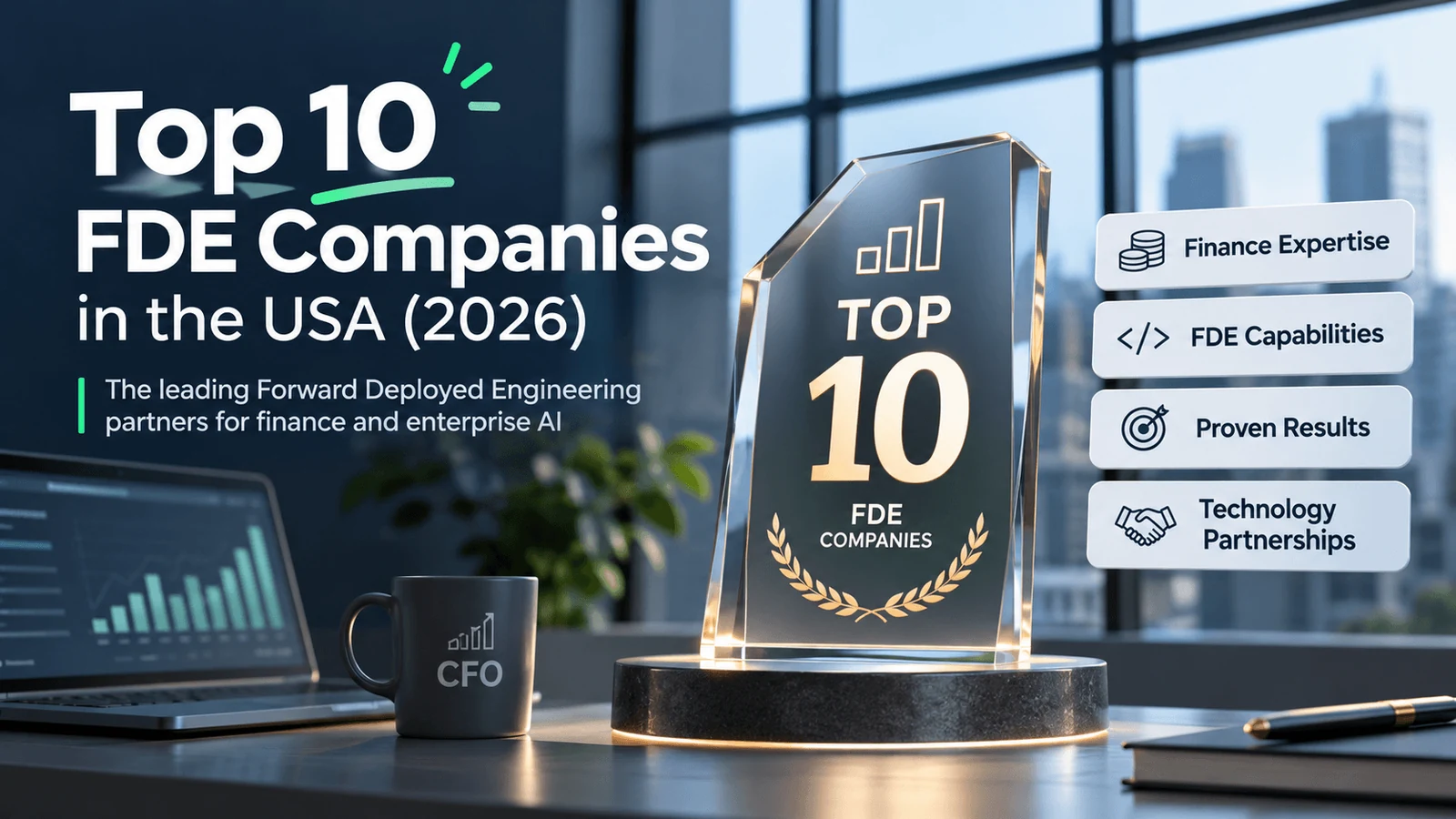
Top 10 Forward Deployed Engineering (FDE) Companies in the USA (2026)
We compared leading Forward Deployed Engineering providers serving the US market, from general-purpose AI engineering firms to specialists in finance and the Office of the CFO.
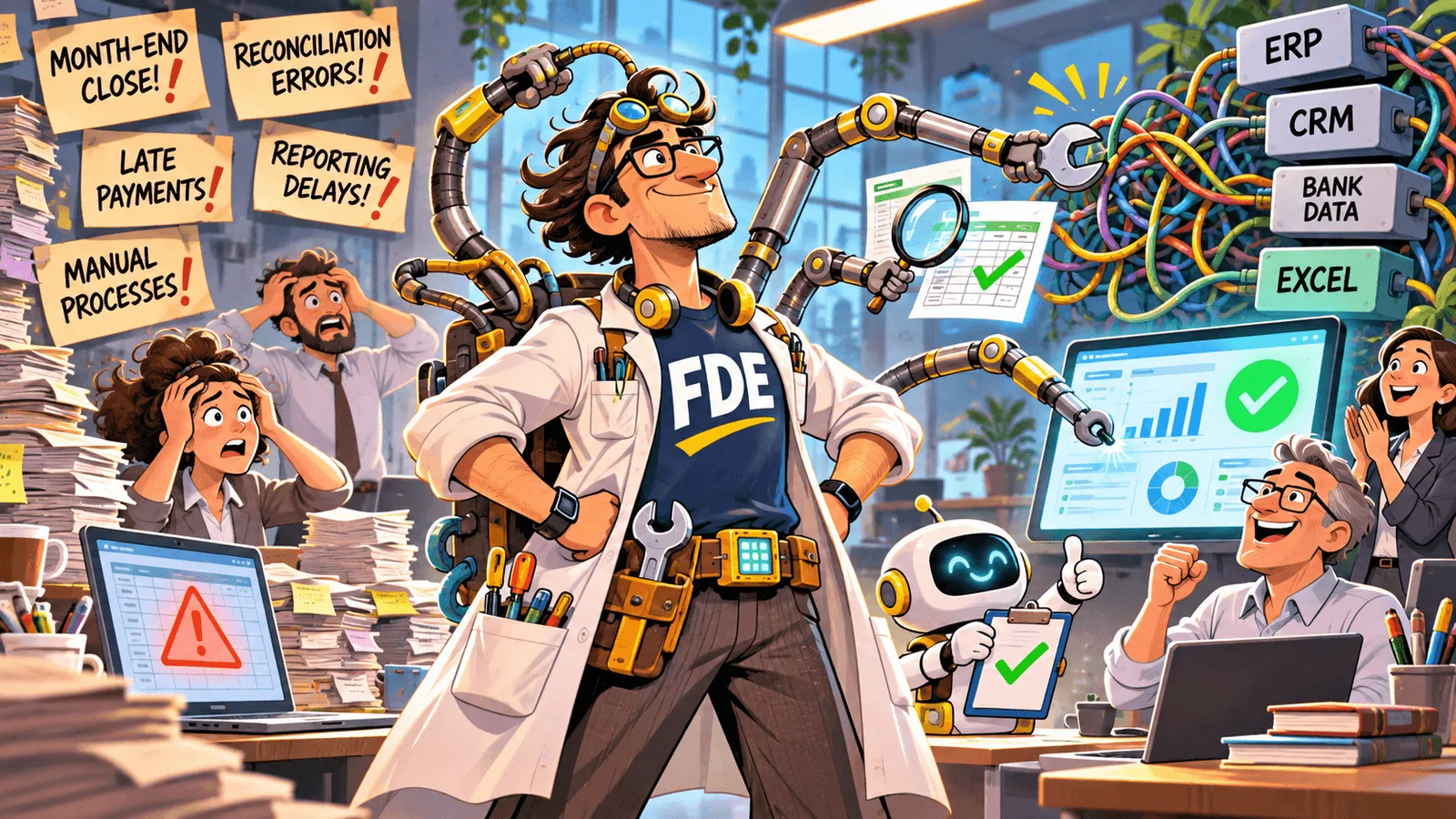
What Is a Forward Deployed Engineer (FDE)? A New Approach to AI in Finance
Forward Deployed Engineers (FDEs) are changing how companies implement AI. Instead of relying exclusively on prebuilt software, businesses can work with engineers who develop solutions around their specific needs. With OpenAI and Anthropic investing heavily in AI deployment, this approach is gaining attention, particularly in finance.

AI Finance Automation: The Complete 2026 Guide for CFOs
A practical CFO's guide to AI finance automation in 2026 — covering reporting, forecasting, month-end close, and how to roll out AI tools without disrupting your finance team.
Practical finance insights, by email
New articles on finance operations, CFO leadership and AI adoption — written for people who run finance teams.